

TL;DR - listen to podcast here
Learning to crochet sounds simple enough.
Pick up a hook. Grab some yarn. Make a slip knot. Pull one loop through another.
And yet, for many would-b
e crocheters, the hardest part of learning crochet is not the yarn, the hook, or even the first stitch.
It is fear.
The fear of trying.
The fear of failing.
The fear of looking foolish.
The fear of discovering that maybe you are not “crafty” after all.
At Exploration Crochet, we talk a lot about crochet as history, culture, community, and creativity. But today, we are talking about something deeply personal: the fear of the first chain.
Because sometimes learning to crochet does not begin with a hook.
Sometimes it begins with hesitation.
When the First Chain Feels Like a Verdict
A lot of beginner crocheters do the same thing before they ever make a stitch.
They buy the yarn.
They pick the pattern.
They save the tutorial.
They may even put the hook and skein into a cute little project bag.
They are ready.
And then…nothing.
The yarn sits there. The pattern waits. The tutorial gets watched, paused, slowed down, restarted, and maybe quietly resented.
On the surface, the reasons may sound practical:
“I’ll start when I have more time.”
“I need to watch a few more videos first.”
“I should find the perfect beginner project.”
“I don’t want to waste good yarn.”
“I’m just not crafty.”
But underneath those reasons, there may be a deeper question:
What if I try and fail?
That is a lot of emotional weight to place on one little slip knot.
For some people, the first chain does not feel like practice. It feels like a test.
Am I creative?
Am I coordinated?
Am I patient?
Am I too old to learn?
Will I look foolish?
Will I prove that I am not the kind of person who can do this?
That is why beginner crochet anxiety is real. The fear is not always about the stitch itself. It is about what we think the stitch will reveal about us.
If my first row is crooked, maybe I am not a crocheter.
If my chain is too tight, maybe I am not good with my hands.
If I cannot follow the tutorial, maybe I am not smart enough.
If I make a mistake, maybe I should stop.
But here is the truth: the first row is usually crooked.
The first chain is often too tight, too loose, twisted, unstable, and full of personality. That does not mean you are failing. It means you are beginning.
Crochet is not an identity you have to prove before you start.
Crochet is a skill you build by doing it.
A crocheter is not someone whose first stitch was perfect.
A crocheter is someone who kept making stitches.
Roman’s Skinny Scarf and the Courage to Begin
In the fall of 2024, my son Roman founded Yarn Over Hook. At the time, he did not know how to crochet. He focused on strategy, business, and technology, while leaving the stitching to me and my daughter Sammi.
Then, on June 12, 2026, Roman published his first crochet pattern.
Within two weeks, he had moved 20 copies.
Granted, it was free.
But still.
Twenty people wanted Roman’s Skinny Scarf™ Crochet Pattern, a pattern that includes an Official Certificate of Skinny Scarf Completion.

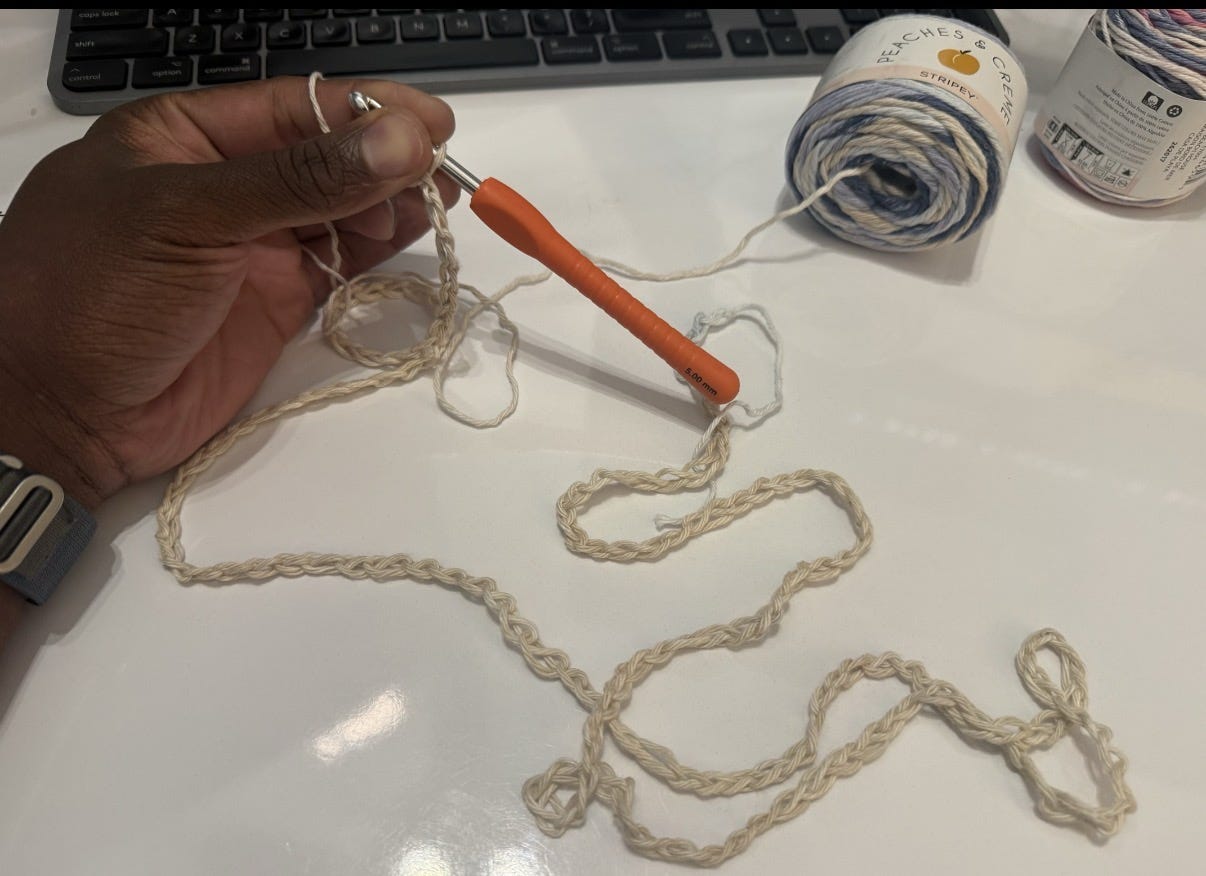
The design is beautifully simple: one chain, 503 times.
That is it.
Five hundred and three stitches.
Why 503?
Because Roman accidentally miscounted one of his groups of 50 and decided that, instead of frogging back three stitches, the extra three felt more bespoke.
And honestly?
That is crochet.
Sometimes you make the stitch. Sometimes you miscount. Sometimes you frog. Sometimes you decide the mistake is part of the lore.
Roman’s Skinny Scarf is funny, yes. But it also points to something important: every crocheter starts somewhere.
Some begin with blankets.
Some begin with amigurumi.
Some begin with garments.
And some of us get really comfortable making chains.
That still counts.
Fear of Failure and Beginner Crochet Anxiety
The Cleveland Clinic describes fear of failure, or atychiphobia, as an intense fear of negative evaluation or failure that can cause someone to avoid activities where an unsuccessful outcome is possible.
Most nervous beginner crocheters do not have a clinical phobia. But the pattern is recognizable.
Fear can make people avoid the very thing they want to do.
And fear often dresses itself up as practicality.
Sometimes “I’m researching” means “I’m delaying.”
Sometimes “I’m waiting until I’m ready” means “I am afraid to be a beginner.”
Sometimes “I’m not crafty” means “I tried something once, and it made me feel bad about myself.”
That matters because many people carry long memories of being corrected, criticized, rushed, or laughed at while learning something new.
Maybe someone told them they were not artistic.
Maybe a teacher made them feel foolish.
Maybe a family member took over instead of letting them try.
Maybe they absorbed the idea that creativity is something you either have or do not have.
But crochet does not work that way.
You do not have to be naturally gifted to begin.
You do not have to understand the whole pattern.
You do not have to make something beautiful.
You only have to begin.
Fight, Flight, Freeze…or Frog
Fear is not only a thought. It is also a physical experience.
Harvard Health explains that stress can trigger the body’s fight-flight-or-freeze response. Even when the danger is not physical, the brain and body can still react to embarrassment, shame, frustration, uncertainty, and judgment as if something unsafe is happening.
And to be clear, crochet is not a tiger.
Usually.
But for a beginner, the emotional task can feel enormous.
What if I can’t do it?
What if everyone else learns faster?
What if I ask a stupid question?
What if my hands will not cooperate?
What if I walk into a yarn shop and feel like I do not belong?

Suddenly, the person is not just learning crochet. They are trying to survive the feeling of being exposed.
That is when fear becomes paralyzing.
Some people fight. They get angry at the hook, the pattern, the tutorial, and possibly the entire fiber arts industry.
Some people flee. They put the yarn away and decide crochet is not for them.
Some people freeze. They sit with the supplies, the video, and the desire to learn, but they cannot start.
This is why “just start” is not always helpful advice.
For someone who is afraid, “just start” can sound like “just jump.”
What they need is not more pressure.
They need safety.
When Preparation Becomes Procrastination
Avoidance is one of fear’s favorite tools because it works immediately.
If trying crochet makes me anxious, and I avoid trying crochet, my anxiety goes down. That relief teaches my brain, “Avoiding helped.”
So next time, I avoid again.
Not because I do not want to crochet, but because avoiding has become the easiest way to feel safe.
Modern beginners also face another challenge: they are learning in a world full of perfect images.
Instagram shows finished blankets being unfurled like fiber art theater.
YouTube shows pretty nails and confident hands.
TikTok shows speed crocheters making cardigans before the coffee gets cold.
Then a beginner looks down at their first chain and thinks, “Mine does not look like that.”
Of course it does not.
You are comparing your first five minutes to someone else’s five thousand hours.
The internet often hides the messy middle. It does not always show the frogged rows, the tangled yarn, the uneven edges, the sleeves that came out two different sizes, or the projects that wandered into a bag and were never seen again.
Skill does not arrive fully formed.
Skill is grown.
Stitch by stitch.
Mistake by mistake.
Frog by frog.
And depending on your temperament, swear word by swear word.
How to Break Beginner Crochet Paralysis
The cure for fear is not “try harder.”
Fear needs safety, evidence, and repetition.
If the fear is, “I will fail,” we need to make failure survivable.
If the fear is, “I will look stupid,” we need to make beginnerhood normal.
If the fear is, “I cannot do this,” we need tiny pieces of evidence that show, yes, you can.
A slip knot.
A chain.
A row.
A mistake noticed without despair.
A project returned to after frustration.
That is how fear begins to loosen its grip.
Step One: Deconstruct the Skill
Crochet has a lot of moving parts at the beginning.
You are holding the hook.
You are holding the yarn.
You are controlling tension.
You are watching the loop.
You are listening to instructions.
You are trying to remember whether “yarn over” means the yarn goes over the hook or the hook goes over the yarn.
That is a lot.
In learning theory, this is connected to cognitive load: our working memory can only handle so much new information at one time.
So lower the load.
Do not try to learn “crochet” all at once.
Learn one tiny piece.
Hold the hook.
Hold the yarn.
Make a slip knot.
Make five chains.
Pull them out.
Make ten more.
Pull them out again.
Make twenty chains and keep going.
This is not wasted effort.
This is your brain, your hands, the hook, and the yarn learning how to work together.
The point is not always the object.
Sometimes the point is that you are learning how to talk to yarn.
The resulting snake is just the cherry on top.
Step Two: Reframe Mistakes as Data
This is where a growth mindset matters.
A fixed mindset says, “I am bad at this.”
A growth mindset says, “I am new at this.”
A fixed mindset says, “My edge is uneven, so I must not be creative.”
A growth mindset says, “My edge is uneven, so something changed in my stitch count or tension.”
That uneven edge is not a moral failing.
It is data.
That dropped stitch is not evidence that you are unworthy of the yarn.
It is data.
That chain that starts loose and slowly becomes tighter than a pickle jar lid?
Data.
Crochet gives feedback. Sometimes that feedback is ugly. But it is still feedback.
If your chain is too tight, your yarn is telling you where tension is showing up.
If your row is getting wider, you may be adding stitches.
If your row is getting narrower, you may be skipping stitches.
That is not shame.
That is information.
And information can be used.
Step Three: Embrace the Frog
In the fiber community, ripping out stitches is often called frogging because you “rip-it, rip-it.”
Beginners need to know this early: frogging is not failure.
Frogging is not shameful.
Frogging is not proof that you should quit.
Frogging is not the opposite of progress.
Frogging is part of crochet.
Experienced crocheters frog.
Designers frog.
Teachers frog.
The calm person at the yarn shop who looks like she was born knowing how to make lace?
She frogs.
We all frog.
Frogging is how crochet lets us revise.
That is one of the quiet gifts of the craft: the yarn lets us begin again.
So if fear says, “Do not start unless you can do it perfectly,” crochet answers, “Start anyway. We can always frog it back and try again.”
Begin Small and Let It Be Ugly
If you are a beginner who feels frozen, do not begin with a project.
Begin with a five-minute appointment.
For five minutes, hold the hook and yarn.
For five minutes, make slip knots.
For five minutes, make chains.
For five minutes, practice pulling one loop through another.
When the timer ends, you are allowed to stop.
This matters because fear often inflates the size of the task. It tells you that learning crochet means committing to a blanket, a lifestyle, a stash, and possibly a tote bag that says, “I crochet so I don’t unravel.”
But beginning does not have to be big.
Beginning can be five minutes.
If five minutes goes well, maybe tomorrow you do seven.
If it goes badly, you still did five.
That is evidence.
Fear said you could not start.
You started.
And when you are ready for a first project, please allow that project to be free of emotional entanglements.
Do not make your first project a gift. Make it a secret.

Your first project should be allowed to be ugly.
Make something small.
Make something for yourself.
Make something for your dog.
Make a coaster.
Make a dishcloth.
Make a scarf for a stuffed animal.
Make a tiny square that never has to justify its existence.
A good beginner project is not the project that proves you are talented.
A good beginner project is the project that teaches you to come back.
What Crochet Gives Back
There is a study with a wonderful title: Happy Hookers: Findings from an International Study Exploring the Effects of Crochet on Wellbeing.
The study was published in Perspectives in Public Health and gathered about 8,400 valid responses from crocheters in 87 countries. Many respondents reported that crochet made them feel calmer, happier, and more useful.
Now, let’s be clear and factual: this was survey-based research. It does not prove that crochet changes brain chemistry. It does not prove that crochet raises serotonin. And crochet is not a replacement for therapy, medication, medical care, rest, or community support.
Let us not make yarn do more labor than it has already agreed to do.
But the study does tell us something important: many crocheters experience crochet as calming, creative, relaxing, and satisfying.
And that is a beautiful thing to place beside the fear of beginning.
Because the very thing a beginner may be afraid to start — the hook, the yarn, the loops, the imperfect first chain — may become one of the things that helps them feel calmer once they let go of being perfect. (And I know for folks who have been crocheting a while…calming and relaxing isn’t always the case: frustrating, confusing, irritation…but still we rise!)
Fear says, “Do not begin until you feel confident.”
But crochet may work the other way around.
You do not wait for confidence and then make the chain.
You make the chain, awkwardly and imperfectly, and confidence begins to grow from the evidence.
One loop.
One stitch.
One tiny bit of proof that fear did not get the final word.
Why Crochet Communities Matter
How we talk to beginners matters.
When someone is afraid to try, they are listening for danger. They are listening for judgment. They are listening for signs that they do not belong.
And unfortunately, fiber spaces can sometimes be intimidating.
If a beginner walks into a yarn shop and feels dismissed because they crochet instead of knit, that matters.
If someone asks a basic question online and receives sarcasm instead of help, that matters.
People do not just remember what they were taught. They remember how they felt while learning.
So if we want more people to crochet, we have to make room for beginners to be beginners.
We have to stop treating confusion as a character flaw.
We have to stop treating mistakes as evidence that someone is not cut out for the craft.
We have to stop guarding crochet like it is a gated community.
Crochet has always traveled through hands. It belongs to anyone willing to pick up the hook.
Sometimes the most generous thing an experienced crocheter can say is:
“Mine looked like that at first, too.”
That sentence can save a beginner.
Because it tells them they are not uniquely untalented.
They are simply new.
Supportive teaching sounds like:
“This part takes practice.”
“Your hands are learning.”
“That mistake is common.”
“Your first row is doing first-row things.”
A good crochet community does not only celebrate finished objects.
It celebrates attempts.
It celebrates first chains.
It celebrates lumpy squares.
It celebrates the person who came to class nervous and left knowing how to yarn over.
That matters.
Because crochet happens in the awkward beginning, the uneven tension, the counting and recounting, the mistake you did not notice until three rows later, and the decision to keep going.
That is why crochet is such a powerful metaphor for courage.
Courage is not the absence of fear.
Courage is making the chain while fear is still in the room.

A Permission Slip for Beginner Crocheters
To the person who wants to crochet but has not begun:
Maybe you have the yarn already.
Maybe it is still in the bag.
Maybe you bought it three months ago.
Maybe you bought it three years ago.
Maybe you have been telling yourself that someday you will learn.
Here is what I want you to know.
You are allowed to start badly.
You are allowed to be slow.
You are allowed to forget.
You are allowed to ask the same question more than once.
You are allowed to make a chain and pull it apart.
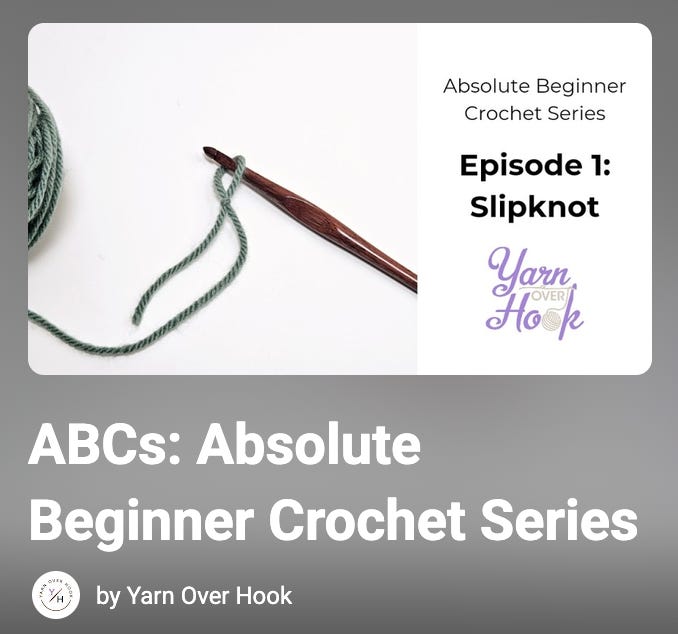
You are allowed to need the beginner tutorial, even if the title says “absolute beginner” and somehow still assumes you were born knowing how to yarn over.
You are allowed to learn in five-minute pieces.
You are allowed to become a crocheter without being “naturally gifted.”
Because most of crochet is not talent.
Most of crochet is return.
You return to the stitch.
You return to the row.
You return after a mistake.
You return after frustration.
You return after the yarn has betrayed you in a public setting.
And eventually, all those returns build skill.
So here is your beginner’s permission slip:
You do not have to make something useful today.
You do not have to make something pretty today.
You do not have to understand the whole pattern today.
Today, you only have to make one chain.
And if one chain is too much, make a slip knot.
And if a slip knot is too much, just hold the yarn.
And if holding the yarn is all you do today, then today you met the craft at the door.
That counts.
The First Chain Only Asks You to Begin
Going back to Roman’s Skinny Scarf, yes, it started out as a gag. But Roman’s Skinny Scarf has become an endearing part of Yarn Over Hook lore because it reminds us that every crocheter starts differently.
Some begin with blankets.
Some begin with amigurumi.
Some jump straight into garments.
And some of us get really comfortable making chains.
Whatever you make first does not have to be great.
It only needs to exist.
Because once it exists, you are no longer standing outside the craft.
You are in it.
And if you are looking for a crochet community that will celebrate even your smallest wins, Yarn Over Hook was built for exactly that: a place where makers can create, learn, connect, and begin wherever they are.
The first chain does not ask you to be perfect.
It does not ask you to be fearless.
It does not ask you to be naturally talented.
It only asks you to begin.
Pick up the hook.
Make the chain.
Let it be messy.
Fear does not get the final word.
Roman’s Skinny Scarf™ | free pattern
Yarn Over Hook | Social Media for Crocheters
Yarn Over Hook | ABCs: Absolute Beginner Crochet Series