
Hooks for Humanity: The Red Cross and the Birth of the Crochet Corps (companion blog)
How Florence Marshall, ARC-400, and the American Red Cross Created the First Nationwide Fiber Arts Volunteer Network During World War I

TL;DR - listen to podcast here
When most people think about the American Red Cross during World War I, they think of nurses, ambulances, and battlefield aid.
Few think about yarn.
Yet during World War I, the American Red Cross organized one of the largest volunteer maker movements in history. Millions of Americans learned to knit, followed standardized patterns, and created handmade garments for soldiers serving overseas. While knitting often takes center stage in this story, the systems developed by the Red Cross would ultimately shape organized crochet charity work for generations to come.
This is the story of Florence Marshall, ARC-400, the famous “Knit Your Bit” campaign, and the birth of what might be called the Crochet Corps.
Charity Crafting Before World War I
Before World War I, charity crochet and knitting were already common.
Church groups created handmade items for fundraisers. Women’s organizations donated garments and household goods to hospitals and orphanages. Charity bazaars sold crocheted lace, collars, baby clothing, and household items to raise money for worthy causes.
But these efforts were mostly local.
There were no national standards. No coordinated collection systems. No organized distribution networks. No way to mobilize thousands of makers around a shared mission.
If you wanted to help, you helped your local community.
That would change dramatically in 1917.
Florence Marshall and the Woman’s Bureau
When the United States entered World War I in April 1917, the American Red Cross faced an enormous challenge.
The military needed vast quantities of handmade garments:
Sweaters
Socks
Wristlets
Mufflers
Balaclavas
Hospital supplies
Comfort items
The question wasn’t simply how to make them.
The question was how to organize millions of civilians to make them correctly.
The American Red Cross Executive Council responded by creating the Women’s Advisory Committee, which soon established the Woman’s Bureau in May 1917.
To lead it, they selected Florence Marshall.
Marshall came from a background in vocational education and women’s training. She understood something that would become critical to the war effort:
Good intentions are not enough.
People need organization.
People need instruction.
People need a system.
Her task was deceptively simple:
How could ordinary civilians systematically support the military?
Her solution would mobilize millions.
ARC-400: The Little Book That Changed Everything

Under Florence Marshall’s leadership, the Woman’s Bureau became the command center for one of the largest volunteer production efforts in American history.
The biggest challenge was consistency.
Volunteers used different yarns, different tools, different techniques, and different dimensions.
That might work for a family sweater.
It would not work for military supply.
To solve the problem, the Red Cross developed standardized instructions known as ARC-400.
Officially titled Instructions for Knitting, ARC-400 established:
Approved yarns
Approved dimensions
Approved tools
Approved construction methods
Standardized sizing
Today, these ideas seem perfectly normal.
In 1917, they were revolutionary.
The Red Cross even established its own needle-sizing standards because commercial needle sizes were not yet universally standardized.
Decades before modern yarn standards and more than sixty years before the Craft Yarn Council was formed, ARC-400 created a framework that allowed thousands of volunteers to work from the same instructions.
In many ways, ARC-400 helped create one of the first large-scale standardized maker communities in American history.
Knit Your Bit: America’s Wartime Maker Movement
A system only works if people participate.
The Red Cross launched one of the most successful volunteer recruitment campaigns ever undertaken.
Its slogan was simple:
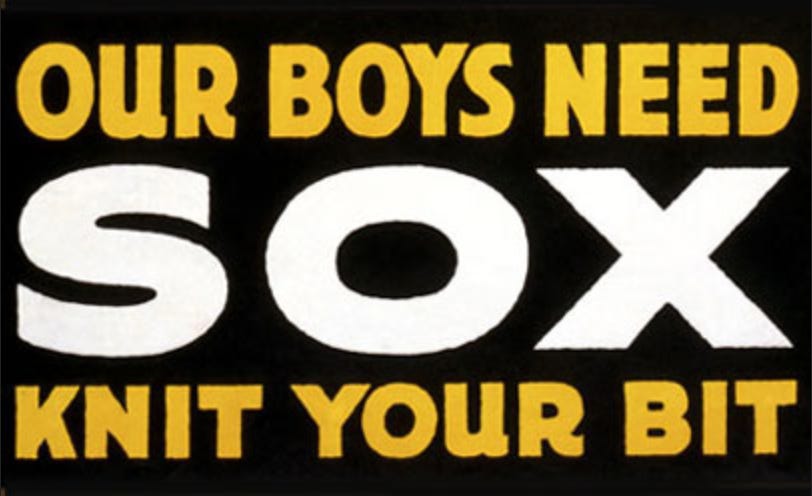
Knit Your Bit
The campaign appeared everywhere.
Propaganda posters encouraged Americans to support the troops.
Women’s magazines published patterns and instructions.
Newspapers promoted local Red Cross workrooms.
Yarn manufacturers partnered with the effort.
Everyone had a role to play.
The result was a remarkable collaboration between humanitarian organizations, publishers, manufacturers, and volunteers.
Teaching a Nation to Knit
One of the most fascinating aspects of the campaign is that the Red Cross didn’t assume everyone already knew how to knit.
In fact, many volunteers were complete beginners.
Contemporary accounts describe:
Knitting classes for novices
Workplace instruction programs
School programs for children
Men learning to knit during lunch breaks
Red Cross workrooms organized specifically to teach newcomers
The Butterick Publishing Company famously reported that employees learned to knit in just two half-hour lessons before producing garments for sailors.
If everyone already knew how to knit, these programs would have been unnecessary.
The Red Cross wasn’t simply looking for makers.
It was looking for people willing to become makers.
And millions answered yes.
The Numbers Are Almost Unbelievable
The results were extraordinary.
When Florence Marshall began her work in 1917, the American Red Cross had approximately 562 chapters.
Twenty months later, by the end of the war, that number had grown to 3,724 chapters.
Membership reached:
20 million adults
11 million Junior Red Cross members
More than thirty million Americans became connected to a single humanitarian organization.
During the twenty-month period of American involvement in World War I, Red Cross volunteers produced:
7,142 afghans
985,841 balaclavas
901,830 mufflers
3,592,126 pairs of socks
4,208,935 sweaters
1,199,420 wristlets
3,801 miscellaneous items
More than four million sweaters.
More than three and a half million pairs of socks.
Nearly one million balaclavas.
Every one of them made by hand.
A Few Forgotten Stories
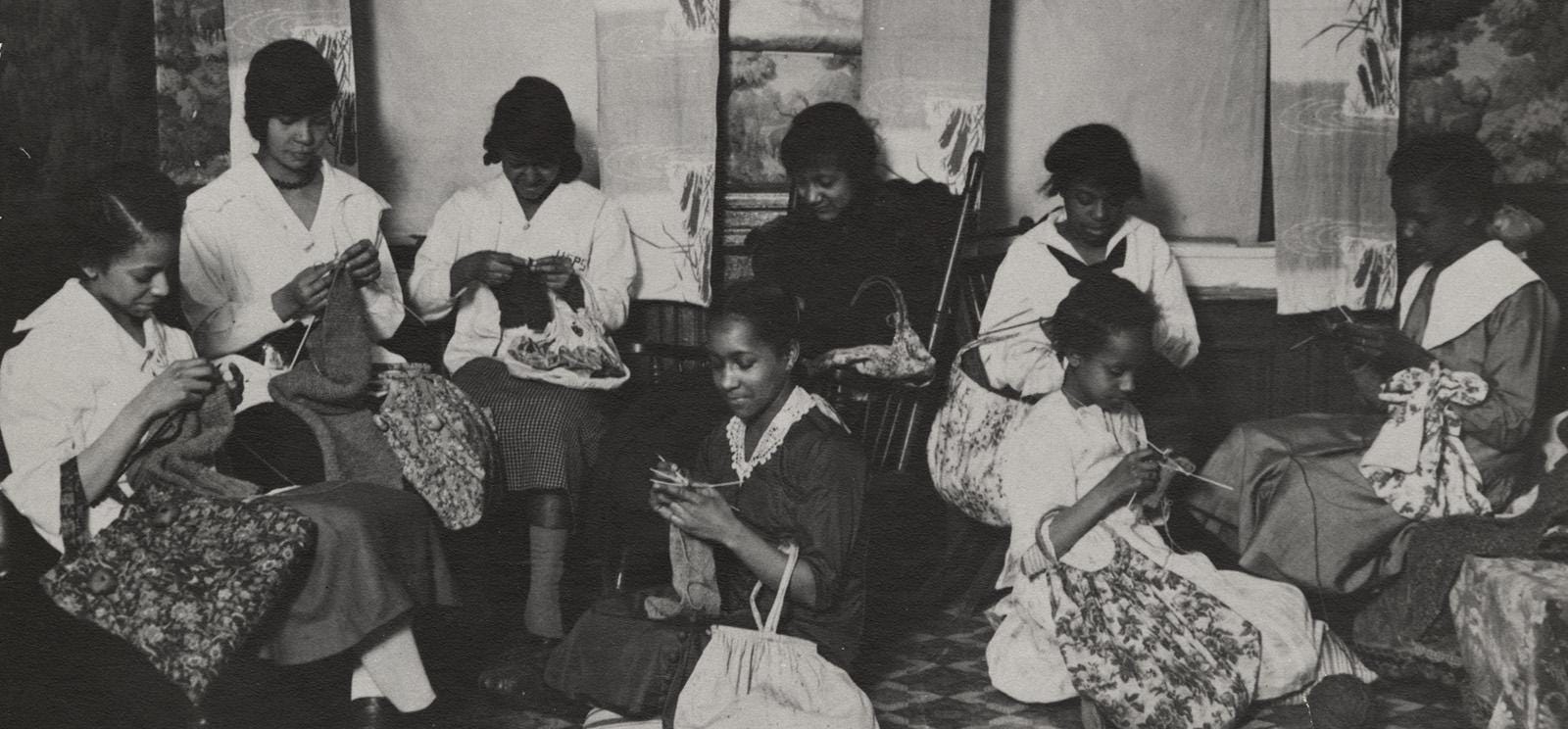
The June 1918 issue of Red Cross Magazine featured a photograph of girls from Chinatown knitting garments for the war effort.

The caption proudly noted:
“They knit sweaters and the more difficult garments, their work is exquisite, perhaps the best the Red Cross gets.”
The same issue also included photographs of young boys making wooden knitting needles.
Meanwhile, President Woodrow Wilson maintained a flock of sheep on the White House lawn. Some of the wool was auctioned to support the war effort, while some was used directly by Red Cross volunteers creating military garments.
But What About Crochet?
The historical record overwhelmingly focuses on knitting because during WWI most military garments were knitted.
However, crochet was never entirely absent.
If you examine Red Cross patterns from the era, you’ll find instructions for rows of single crochet used around neck openings and armholes during finishing.

Crocheters also contributed to relief work, comfort items, household goods, and later Red Cross charitable projects.
Most importantly, crochet inherited the infrastructure.
The systems that allowed millions of knitters to coordinate their efforts became the blueprint for organized fiber charity work of every kind.
Including crochet.
The Legacy of the Crochet Corps
The armistice arrived in November 1918, but the relationship between makers and the Red Cross did not end.
The organization continued relief efforts during the Spanish Flu pandemic and expanded maker programs throughout the decades that followed.
When World War II began, the Red Cross once again mobilized millions of volunteers.
The U.S. War Production Board designated the American Red Cross as the sole clearing agency for military knitting projects. Millions more garments were produced through standardized patterns and organized volunteer networks.
The framework created by Florence Marshall and ARC-400 continued to prove its value.
And that framework still exists today.
Organizations such as:
Project Linus
Warm Up America
Knots of Love
Knitted Knockers
all rely on familiar principles:
Standardized patterns
Approved materials
Quality requirements
Collection sites
Distribution networks
Volunteer makers
The Red Cross didn’t invent charity crafting.
People had been donating handmade items for generations.
What the Red Cross did was organize it.
Scale it.
Standardize it.
And prove that thousands of strangers could work together through shared patterns and shared purpose.
The Birth of the Crochet Corps
There was never an official Crochet Corps.
But the idea captures something important.
Florence Marshall never commanded troops.
She never served in a trench.
Yet she helped build a volunteer army measured in stitches.
Today, whenever crocheters gather to make blankets for the unhoused; hats, wigs, and boobs for cancer patients; soap sacks for communities in need; or comfort items for strangers they’ll never meet, they are participating in a tradition that traces its roots back to those early Red Cross maker networks.
The Crochet Corps may never have officially existed.
But its legacy certainly does.
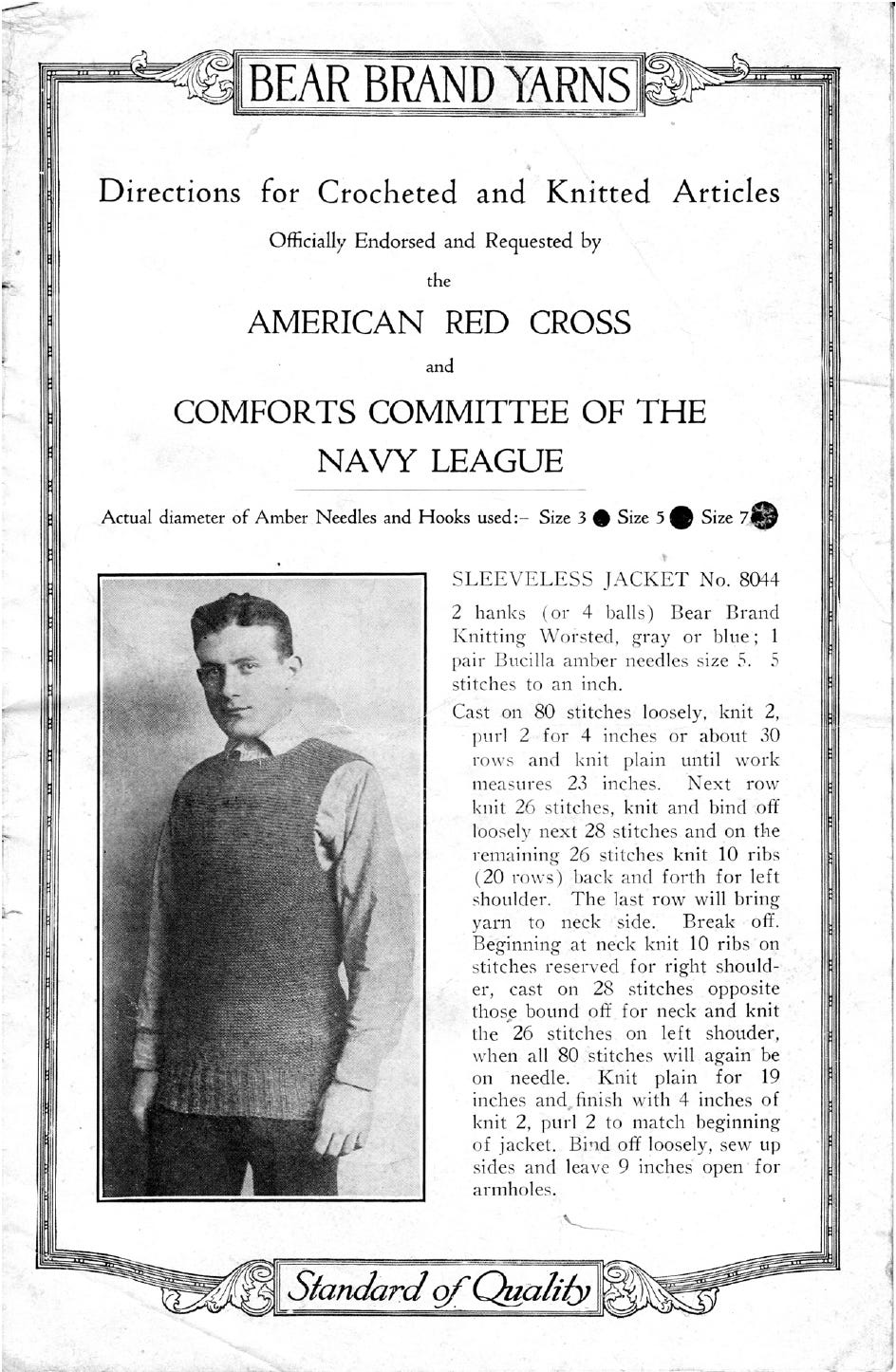
Bear Brand Yarns: Directions for Crocheted and Knitted Articles

Library of Congress Blog | https://blogs.loc.gov/headlinesandheroes/2026/04/knit-your-bit/
American Red Cross: Instructions for Knitting | https://collections.theworldwar.org/argus/final/Portal/Default.aspx?component=AAAS&record=6eec2929-de90-427f-91aa-6911f1d1a1da
Knitting the Nation | https://www.theworldwar.org/learn/about-wwi/knitting-nation
Men’s Sleeveless Sweater for Navy Use | https://digital.centerforknitandcrochet.org/items/show/8892
FREE Red Cross First Aid Kit Pattern | https://www.yarnspirations.com/products/red-heart-red-heart-cares-crochet-first-aid-kit?srsltid=AfmBOoqZexOoH3_D7KmPz2sQWFg9JeXKz_u7TZzcod9DKkmkW3XP1IEe
Read aloud: Knit Your Bit: A World War I Story |